Thursday, January 19, 2012

Strong to the Finish - Spinach

Popeye picture - compliments of free Google Images

Family: Amaranthaceae (originally Chinopodiaceae)
Genus: (Spinacia oleracea)

When I was a kid I had a thing for Popeye cartoons. It was a mixture of Popeye’s more-than-muscular forearms sporting tattoos and bursting out of his cool sailor outfit, Wimpy with his passion for eating stacks of juicy burgers, and the strangely awkward Olive Oyl.  Here is what I figured as an equally awkward kid: if Olive could get Popeye and Bruto to swoon and fight over her, then all of us females had a chance for romance. Who knew that one day I would grow up and marry a man with only one good eye just like Popeye!

The spinach magic that Popeye used to boost his power was not lost on me; if my mom served it for dinner, I ate it – even if it had a slightly bitter taste. As I grew older, I realized the canned vegetables that Popeye devoured were inferior to the taste and nutritional goodness of fresh vegetables.  I wish I could have talked to Popeye about that and offered him a baby spinach salad.

Unless you have been living under a rock, you have heard about the “super foods” – foods that are packed with a powerful punch of nutrition and should be included daily (or at least weekly) in the human diet. In my blog I have discussed several super foods (i.e. Yams/Sweet potatoes, cabbage). Spinach is one of the green leafy super foods. Read up on the fun facts I gathered from various sources and then check out the spinach salad recipe with pears and O & CO balsamic vinegar. Popeye, would devour this recipe and then go on to save the world. Well, somebody has to.

SPINACH FUN FACTS
  • Spinach is a dark green leafy cold-weather annual. In most zones you can plant seeds in March and have baby spinach salads in about 4-6 weeks, then plant again in the fall for a later harvest.
  • Origin is not precisely known but spinach possible hails from Persia or Nepal. How exotic!
  • The Chinese consider it a “cooling” vegetable or having the yin effect of calming the body. It is helpful for people who often feel hot and perspire, have red eyes, skin issues, heart burn, and constipation.
  • Vitamin A – a whopping 31,882 IU of A (carotenoid form) and 1595 of A (retinol or RAE form) in a bunch of spinach (USDA Nutrient Data Library).  Vitamin A enhances skin and mucous membranes, vision, immune system, bone growth, infection fighting, and reproduction. It also reduces risk of cancer; also it is a skin-enhancing and healing antioxidant compound that fights free radicals.
  • Vitamin C – with almost 50% of the daily requirement in 100g of spinach, the positive healing properties of ascorbic acid are:  Anti-oxidant that boosts the immune system and assists the body in making collagen, a protein necessary for skin, cartilage, tendons, ligaments, and blood vessels. Vitamin C is needed for healing wounds and for repairing and maintaining bones and teeth (National Institute of Health).
  • Vitamin K – K for koagulation (German spelling), essential in blood coagulation and for bone strength and formation (Linus Pauling Institute). Spinach (100g) contains an amazing 400% of the daily requirement of K (USDA).
  • Folic acid or B9 - available in spinach and needed by the body to manufacture red blood cells; a Vitamin B9 deficiency can cause certain types of anemia.
  • Iron – 100g of spinach contains 25% of our daily requirement of iron. Iron, as part of the protein hemoglobin in our blood, carries oxygen from our lungs throughout our bodies as well as assisting our muscles to use and store oxygen. 
  • Spinach plays a pronounced role in healing age-related diseases. It contains zeaxanthin, a cartenoid, which when absorbed into the retinal macula lutea is beneficial in fighting Age Related Macular Disease (ARMD). In addition, the Vitamin K in spinach plays a role in limiting neuronal damage in Alzheimer’s and also is enormously important for bone strength and mass!
  • Contains oxalic acid - which can have the positive effect of stimulating colon activity but the negative effect of crystallizing as oxalate stones in the urinary track (so drink lots of water!) However, cooking/steaming will reduce the oxalic acid quantities.
  • Last but not least - there was an E. coli and salmonella scare in the last few years attributed to fresh spinach; this can occur in any agricultural environment. The situation  was investigated and corrected. Always be sure to wash your spinach very well making sure each leaf is rinsed. 
Spinach salad ala fancy balsamic vinaigrette and pears (note the O &CO balsamic vinegar)

SPINACH SALAD - ala fancy balsamic vinaigrette and pears

When Bumble and I were in Paris for a divine travel vacation, we stumbled across the 
O & CO on Rue Cler, a Mediterranean food merchant emporium specializing in all things created from the olive (olive oil, tapenades) along with products that compliment like vinegars, sauces, and crackers. It was here we sampled and tasted their best-selling “Premium Balsamic Vinegar of Modena.”  Quite frankly, it takes balsamic vinegar to a whole other heavenly level. Worth every cent of the $34 price tag, it will make anything you top it with sing an opera.  We were thrilled to find out we have an O & CO right here in Cherry Creek, and we don’t have to order this scrumptious vinegar from France.


INGREDIENTS (salad)
1 package organic baby spinach (washed, drained and spun)
1-2 ripe pears sliced thin
1 C. cherry tomatoes (amounts can be adjusted)
½ C. dried cranberries or more to taste
½ C. honey roasted pecans or slivered almonds
½ C. crumbled goat cheese (Feta) - if you dislike goat cheese sprinkle on Parmesan instead
Note: add any other fresh vegetables you love such as avocados, peppers, green onions
Salt and pepper

DRESSING

2 T. Tamari or soy sauce
3 T. O & CO Balsamic Vinegar of Modena (really crucial to divine flavor see photo)
3-4 T. Extra Virgin Olive Oil

Whisk the 3 ingredients together and adjust for flavor and consistency. Use your taste buds to determine. Toss with the spinach salad ingredients above and serve. Enjoy the benefits from all the vitamins and minerals!

References
http://ndb.nal.usda.gov/ndb/foods/show/3233
http://www.nutrition-and-you.com/spinach.html
http://www.theherbprof.com/clnsSpinach.htm
http://www.nutritionj.com/content/2/1/20
http://www.nlm.nih.gov/medlineplus/ency/article/002400.htm
http://ods.od.nih.gov/factsheets/vitamina
http://www.umm.edu/altmed/articles/vitamin-c-000339.htm
http://lpi.oregonstate.edu/infocenter/vitamins/vitaminK/
http://www.ncbi.nlm.nih.gov/pubmedhealth/PMH0000723/
http://www.cdc.gov/nutrition/everyone/basics/vitamins/iron.html
http://www.pingminghealth.com/article/581/warming-and-cooling-characteristics-of-common-foods/
http://www.oliviersandco.com/
http://www.oliviersandco.com/vinegars/premium-balsamic-vinegar-of-modena.html


Monday, January 9, 2012

Native Voices

Fancy Dancer Rylan Baker - Photo courtesy Google Images and geneva.usmission.gov


Every January the cowboys come to town. All things cowboy and western - from livestock to leather boots, felt fedoras to bucking broncs – gather at the Coliseum to swing their tails and tell their tales in Denver, Colorado. For a few weeks in January, the well-known and infamous National Western Stock Show which began its century-old tradition back in 1906, comes to town. The Stock Show, as it is known locally, was born 106 years ago as an idea invented by livestock growers in Colorado to boost recognition (and sales) for their work (i.e. livestock and agricultural products) and compete with more popular meat-producing cities in the east such as Kansas City and Chicago. January was chosen as a great time (after the holidays and a winter lull in sales) to command attention from the public. It has been a dramatic draw ever since, growing from a local event to a national one. For more information see http://www.nationalwestern.com/.

However, long before all the old world animals such as sheep, cattle and pigs were introduced to the Americas by European invaders and shown at the stock show; the magnificent American bison (Bison bison) roamed the western Great Plains. Before the West was overrun with gun-clad cowboys and Stetson-hatted stockman, there lived an indigenous people. These people hunted the wild game and bison of the region and this food source was crucial to survival. Interestingly, today the bison is finally being recognized as an important source of nutritious, low-fat and naturally grass-fed meat.

They were the original inhabitants - native peoples that inhabited this new world - and they were comprised of well over 500 tribes, numerous nations, and countless clans. While the Spanish Conquistadors were annihilating the peoples in the southern regions - Mexico, Central and South America - the English, Dutch and French were incrementally taking over the North American region. The take-over was complete long before the 19th century came to a close. Like many things from nature that are made near-extinct, their habitat was stolen to make way for a new society and ways. Not only did they bring non-native animals, birds and plants, but diseases such as smallpox which devastated the native populations. These first people’s way of coexisting with the land - the native animals and plants - was destroyed and the American Indians were relegated to spend their lives on reservations. The land of the reservations was too small to sustain a hunter/gatherer society with enough habitat to support herds of native animals. Their ghosts whisper to me of tremendous loss and what it means to be made powerless and marginalized.

Miraculously every Sunday morning without fail at 7 a.m. they have been given a voice to be recognized and heard. Colorado hosts a public radio program called alter-Native Voices in Denver and Breckenridge on KUVO (89.3 FM), in Vail on KVJZ (88.5 FM), and live-streaming on KUVO.org.  For one hour on Sunday morning Susie Aikman, your host and DJ, shares the music of such talents as: Arvel Bird, Bill Miller, Buffy St. Marie, Brule´, Jana, Red Feather Woman, Robert Mirabel, and Carlos Nakai. Interwoven into the playlist are stories, brief history lessons and Native American community events shared to enlighten the listener. Every Sunday, Bumble and I share morning coffee and awaken our ears to hear these voices. It is like being in a church filled with Great Spirit. Tune in and listen to an alternative voice and you will not be disappointed.

Another January tradition happening in Denver that balances the cowboy event of Stock Show is the Colorado Indian Market and Southwest Showcase held January 20-21-22,2012. Beautiful artwork, pottery, jewelry, clothing, furniture, and entertainment are tightly packed into the Denver Merchandise Mart. Here on their stage you can experience live the music you may have sampled listening to at alter-Native Voices. This month you can hear the music of award-winning Brule´ and Shelley Morningsong, and experience Tom Ware's American Indian Exposition Dancers. Watching Native American dancers is heart-stopping. The energy, rhythm and colors will mesmerize and make a deep impression. I urge you to hear these native voices (on the radio, at the upcoming Colorado Indian Market or a local Pow Wow) and to be changed forever!

Three children dancers - Photo courtesy Google Images


References
http://www.nationalwestern.com/
http://www.nationalwestern.com/history/first-25-years.aspx
http://www.alternativevoices.org/
http://www.indianmarket.net/P7.html
http://geneva.usmission.gov/2009/11/12/american-indian-heritage/

Monday, January 2, 2012

Real Resolutions

My homemade wreath longing to stay outside and 
not be put away in the closet for 11 months.


Nope, I am not going to set myself up for failure with the usual New Year’s resolutions like “lose 15 pounds” or “become fluent in French” or some such unachievable goal.

Instead,  I am going to create a list of resolutions that are achievable and contain a confident spirit; a list that consists of what I know I can do, not what is wrong or missing with my present self. Everyone has heard them before, nothing much new but they are definitely doable.
  1. Choose to exercise an hour every day. It can be any variety of movement – walking, jogging, swimming, biking, practicing yoga, etc. And always allow for one rest day each week. 
  2. 80/20 rule - Choose healthy food over junk food 80% of the time and 20% of the time indulge and eat that piece of cake your hostess made. I can do this!
  3. When feeling low, be kind to self and venture out into nature – go to streams, woods, snow-capped mountains, grassy plains, lakes, or beaches – and simply marvel at something greater than oneself. 
  4. Choose to create a little something every month – write, paint, sew, re-pot a plant, make earrings, try a new recipe. Laugh at the childlike joy of creating.  Come on, it’s only once a month.
  5. Once a month attend one cultural event that will enrich and inspire - go to a museum exhibit, hear music, see a play at a local theater, attend a Native American Indian pow-wow, etc. This is fun!
  6. Listen to my French language tapes 2 or 3 times a week (you can substitute Spanish, Chinese, Italian, etc.) - the goal is to just listen! I may absorb more and improve without any pressure to become better.
  7. Choose to watch TV less and read or meditate instead. I can do this!
  8. Find one awesome thing about Bumble every week (or every day) and tell him about it. 
  9. Be grateful for the things I do have and learn to let go of things I will no longer have. Gotta do it.
  10. Gravitate toward the people who show love and kindness towards me and let go the people who don’t. It is sad and necessary.  Being unloved and treated unkindly will only make one feel “not good enough” and lacking; this is a recipe for self-loathing. Stay close to the folks who accept the way you are and who forgive your imperfections.
OK, what are yours?

Wednesday, December 28, 2011

Winter Solstice and the New Year

NASA Goddard Photo - The Winter Solstice - 12/22/2011


Circles, cycles, wreaths and rings; round and round we go. Seasons are cycles and cycles are circular and "to everything there is a season." It is no surprise that the wedding ring represents the everlasting commitment of marriage with no defined end. Likewise, wreaths - circles of evergreen boughs symbolizing eternal life - are fitting celebratory decorations for the Christmas holiday.  Winter is a significant part of the year’s cycle.

After the holiday madness is over, the winter solstice should be a time for all of us to go inside during the darkness and take a respite – to pause, rest and renew. Just like the metabolic slow down of hibernating animals during winter or the dormancy period of many plants, humans benefit from this down time also. The cessation is important and is a great gift – we can rethink, reevaluate and revive. During winter, the sleeping seeds of inspiration may later sprout into a garden of delightful changes or ideas. Use the darkness well. In a few short months the next season will be upon us; days will get longer and longer and take back the darkness of winter.

The New Year’s celebration and the fitting image of Janus – the two-faced god looking forward to new beginnings and glancing back on the past – is perfect. Our past is a part of our present and future; it can be the ground from which we grow and change. I think it is important to ponder what is no longer working in one’s life and say good-bye mournfully - then slowly over time reinvigorate it with the surprises life springs upon us. 

When we were children we believed anything could happen in our lives – all was possible. The New Year gives us this mimicry of youth and new beginnings every January. It is a chance to give birth to the possibility of a new self. This is the best present of all! Happy New Year and Bonne année!

Monday, December 19, 2011

They're Back: Beaver along Cherry Creek!


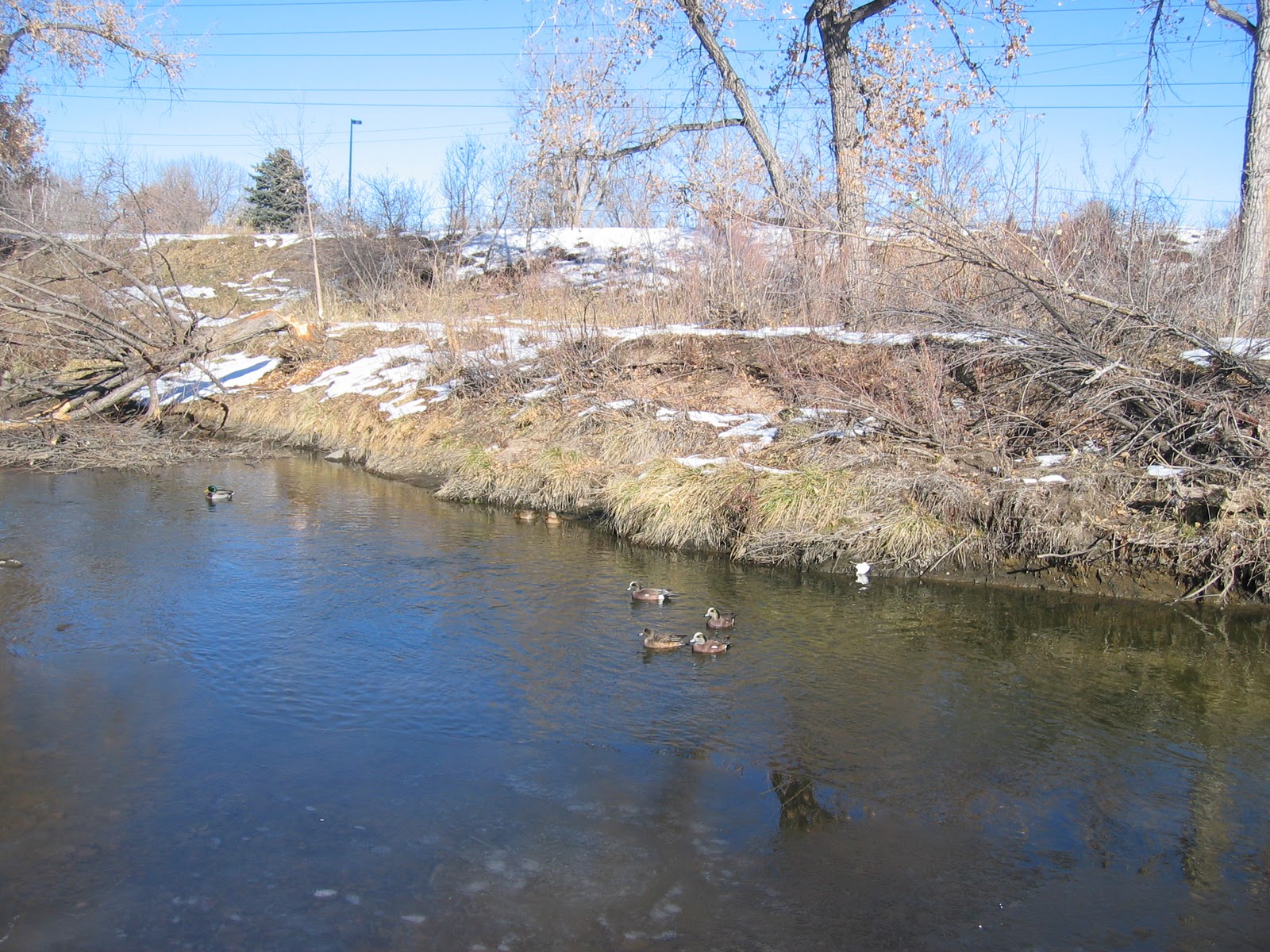
American Wigeons dabbling in Cherry Creek

Walking a stretch of the Cherry Creek bike path lined with the naked willows of winter and the occasional cottonwood tree looming large, I heard the unmistakable sound of a child’s squeaky toy. Well, perhaps it was a dog’s squeak toy? I looked around for a shaggy canine sporting a well-worn rubber toy in his mouth but found none. Glancing further and looking into the stream, I saw the noise makers. There they were - a pair of adorable American Wigeons - complete with their unmistakable pale blue beak. Now, seeing a blue-beaked duck may not excite very many people but to me it is like finding a semi-precious jewel in the dirt. Something not expected on my daily sojourn. I am used to seeing the ubiquitous Mallard in the creek, a handsome duck indeed; yet when I see something other than the Mallards I tend to get excited. And then, not a minute later, I saw a different duck with a huge white cheek mark vivid against its otherwise dark head, a Common Goldeneye. Not that a casual observer can really see his “golden eye” from this distance but that is this duck’s name nonetheless.

These dabbling ducks were enjoying a glassy-surfaced little lake that had been created by twigs, branches, brush, and a felled tree that were slowing down the water flow of the creek. For a few weeks it was hard not to notice the chewed-up remains of tree trunks I had observed along the path, and I knew there could only be one animal doing the chewing. Indeed, it was the North American Beaver (Castor canadensis). This hard working animal had inhabited this creek on and off for centuries. Long ago, about the time that the historic Four Mile House (located a mile downstream) stood as a respite for Colorado immigrants, travelers, and Native Americans, they frequented Cherry Creek until trapping diminished their populations.  How lucky I was living in a city and seeing wildlife doing wildlife things right before my eyes not from a TV screen.
The hard work of the North American Beaver
 
Beavers are what is called a “keystone species,” which is a term given to an animal that alters an ecosystem in such a way that it paves the way for other species to exist in this environment. Like the keystone in antique arched doorway, if it is removed, the whole arch collapses in on itself. The beaver’s diligent dam building creates a wetlands environment that opens a door for other species to inhabit. While it is true that none of us want every cottonwood tree felled along the creek because of the negative impacts this would cause, nor do we desire flooding from the ponds onto private property. However, there are ways to mitigate the beaver’s behavior without destroying this amazing animal. Wouldn't it be interesting if both beaver and humans could both live in and enjoy this area?

Beaver tree sculpture?

For people to coexist with beaver there are several solutions that have been developed. Flexible pipe can be installed as “pond levelers”; these devises are simple (see "beaver solutions"). They allow a creek to continually flow through an opening in the beaver’s dam without completely restricting the water flow thus managing any flooding that is the goal of the beaver's dam. This is a win/win situation; it allows a portion of the beloved pond habitat to remain and the beaver's living quarters while minimizing damage. To protect important riparian area trees from being felled by the beaver, various cylindrical wire cages can be wrapped around the trunks to discourage this behavior. Both solutions are not expensive or difficult to apply.

An amazing feat of dam building

A recent success story of beavers living alongside human development occurred in Martinez, California.  After the town spent huge sums of money to restore a once channeled creek called Alhambra Creek, the waterway became not only more attractive to the human eye but also to a beaver family that quickly took up residence. The beaver started building dams along this nicely refurbished waterway and flooding certain locations. Soon, the beavers and their dams were slated for removal or extermination in October of 2007. An outcry throughout the community allowed for further investigation, research, and education to determine the best way to solve the situation. A community effort called “Worth a Dam” coalesced that saved the beavers along Alhambra Creek. Experts were brought in (Skip Lisle from Vermont) to install a flow device made from flexible pipe. Today the Alhambra Creek beavers, now known as the “Martinez Beavers,” are a large tourist attraction. Their antics are viewed from a town bridge to the delight of children and adults. It has made the locals proud and happy to live successfully with wildlife.


Tuesday, December 13, 2011

Will the real cat please wake up?


Powder pondering his true self.


Who is the real cat inside of us? How do we really know which personae we put out into the world or which mask we wear is the authentic one? The game face that we put on may bring about some wins from time to time but what are we really losing? If we are honest about who we are and let it all hang out, will we be punished by ostracization from society? No one really wants to be banished; we all want connection. I often philosophize about these things.

These thoughts bring to mind a part in the children’s book, “The Velveteen Rabbit,” where the Skin Horse is sharing his knowledge of how he became “real.” In a nutshell, what the Skin Horse says is: becoming “real” takes a really long time, it can hurt, and you lose a ton of hair. Bumble says, “Sounds like the aging process.” 

At the turn of the century, I worked doing US Census taking and my assigned territory included an active adult senior community. Knocking on doors, meeting the residents, and asking them the appropriate census questions led to interesting conversations with these mature folks. After a few days all I wanted to do was sit and listen to their stories – stories of times gone by and of lives remembered in eras I only knew about from Hollywood. They were stories told from a bold perspective of looking back with nothing to lose  - to just share with a stranger. At the time I was so enthralled with the stories coming from these older folks I wanted to record them.  I went to a local documentary film maker and pitched my idea. She said, “Yeah, well no one wants to listen to old people – I am not interested - it won’t go anywhere.” After melting in a heap on the floor with my idea, I wrapped it up and stored in away in my idea file.
 
Dr. Brene Brown - and if you haven’t heard of her work, I suggest you explore it - is a research sociologist. During her doctoral research she found something a bit unexpected from her original predictions and theories. She found that the people who explore and deeply search for a well-lived life all seem to incorporate these three elements:
Authenticity - the courage to be who one really is with emotional honesty,

Connection -  the feeling of love and belonging which begins with compassion and acceptance of all the imperfect parts of oneself and one's life, 

Resilient spirit - the ability to tell one's story and  truth while embracing vulnerability and hope.

Dr. Brown named her discovery “WholeHeartedLiving.” People who exhibit a certain amount of courage and allow themselves to be vulnerable live more authentic lives. The root of the word “courage” is cor (or cuer) or heart -- if one lives a life working towards these elements, they are living with their whole heart. This courage to be vulnerable and imperfect takes compassion and that compassion starts with one’s self. To tell your real story with wholeheartedness means you have to accept yourself with all your warts and hope one day someone else will also. Authentic connections with others happen when we are truly honest about sharing ourselves. One must rise above shame and quiet that awful inner voice which says that we are "not good enough."  Being vulnerable is not a sign of weakness; it is a sign we believe we are "worthy of love and belonging" and that we are good enough just the way we are.  This is really truly amazing!

References

Williams, Margery. The Velveteen Rabbit: Or How Toys Become Real. New York: Doubleday Books, 1958. Print. 

Friday, December 2, 2011

Job Opportunity for a Good Woman

Yes, finally a job that fits some of my qualifications!
(photo taken at Buffalo Bill Museum Cafe)


Having trouble finding the career of your dreams? Having trouble just finding a job that pays over $10/hr.?  You are not alone.  I did the "get an education" thing and equipped myself with several degrees by "following my bliss." After finishing up my most recent educational adventure in 2010, completing a degree in library and information science (MLS) with a 4.0 (yeah, who cares?), I assumed I would be able to find a nice little job in a local library. Information science was something I wanted to share with folks from a research perspective and a creative educational standpoint. I was ready and willing to work part-time and not stress the budget of any library. Salary was the least of my concerns; I just wanted to give back to the community like Oprah always suggests. For almost two years, I worked as a "student worker" in an academic library, gaining experience performing a multitude of tasks and learning the ins and outs of different library software systems. Ready to hit the streets, I sent out into the cosmos of my local library system my clean, clear and concise resume, accompanied by a brief yet informative cover letter. I waited and waited for a response. I applied again.  Um, nothing, nada, rien, nichts, zilch ever came back. Not even a "thank you for your application." I am indeed invisible or my application and resume are. How can a piece of paper transferred to a computer screen reflect the true essence of a person? And what if somebody looks "good on paper" but is really not good in person?

Perhaps I do not have the talent for creating connections with the important people in human resources and networking properly to get my foot in the door. Is there a school for that? Is it really all about who you know or who you are related to? What happened to the days of visiting an establishment and talking with the manager (or department head) letting them determine if you fit their team mold or fold? When was the last time the people who should be intimately involved in putting a team together for their work force could personally experience your smile, personality, or vibe and decide right then and there to hire you (or not)? Now, most job application processes are run through the anonymity of a human resources department where young, inexperienced personnel are mandated to determine from a piece of paper who is a good candidate for various positions. If one is fortunate enough to get an interview, they are then run through the wringer, asked ridiculous and canned phony questions and the equally phony replies are noted in the same fashion as if one were sitting with Dr. Freud. "So where do you see yourself in five years? "Well, I see myself sipping fresh-squeezed-lime juice margaritas sitting on the white sands of Ipanema Beach gazing out at Sugarloaf Mountain about 15 lbs. thinner - tall and tan and young and lovely."  Uh oh, wrong answer. The person who spins and sells the best lie wins. The human resources department might also demand the applicant take a multiple-choice test to be sure he/she fits some psychological profile (or to find out if one has the potential to become an ax murderer). I believe they also scrutinize one's education with the sole purpose to discount and undermine whatever schooling one has mastered in order to come to the conclusion that the applicant falls short of some class and their education is not enough.

Whatever happened to human intuition and gut feelings? One hiring experience I had decades ago and still cherish is the day I walked into a plant nursery for a job and chatted with the owner. I told her briefly about my horticulture experience and passion about all things botanical. The owner said, "Start tomorrow." I asked if she wanted my resume or master gardener certification and she said, "No, I can tell right away what kind of person I want here."  Voila! This is the kind of job interview and hiring practice that is sorely lacking in the post-globalization corporate and bureaucratic world. Put the “human” back in human resources and let the personnel begin again to trust their observations and instincts rather than have job applicants fit a geometric grid or business model. It is hard to get those fleshy round blocks into square holes. Can all those phony canned questions be trashed and an interview become a real conversation between two people who may one day work side by side?

Anyway, back to the job opportunity above: I can sew, cook, gut clean and shovel horse shit as well as the next person. I am a good woman and I still have my saddle and chaps, but not my horse. As a bonus, I can throw together a kitchen garden in the warm season. Any takers?