Monday, July 23, 2012

Zucchinis – gotta love ‘em

One zucchini plant taking over my yard
A while ago I was pondering world hunger and among the solutions I came up with was to provide every needy family or community one zucchini plant (climate permitting). One plant would quickly grow to elephant-sized proportions and provide endless vegetable matter.  It can be eaten raw, stewed, sautéed, stuffed and roasted, or baked into moist and delicious breads.  Adding grated zucchini to a cake batter makes it moist and delicious without imparting any strong flavor.  I make a chocolate zucchini cake that is too die for (but I don’t tell anyone the secret ingredient for fear they won’t eat it).

Zucchini truly is not a difficult vegetable to swallow; it has a fairly bland taste like many vegetables in the Cucurbit family (not strong like broccoli from the Brassica family). It makes for great culinary company when mixed with onions, garlic, basil, fennel, tomatoes, or other squashes. Here are some fun facts about this vegetable:

7 Fun Facts About Zucchini
  1. One average-sized zucchini is just 25 calories (17 calories per 100 grams) and they are fat-free and cholesterol-free.
  2. Zucchini is a good source of Vitamin A, Vitamin C and manganese and has more potassium than a banana. 
  3. They also contain the B-complex group of vitamins like thiamin, pyridoxine, and riboflavin.
  4. The beautiful yellow flowers are edible – fried squash blossoms are epicurean delights.
  5. Wash your zucchini but don't peel them because most of the nutrients are in the skin.
  6. Every year there is a Zucchinifest celebrated in Obetz, Ohio, with food, music, motorcycles, parade and pageant. This year it is set for August 23-26!
  7. In France and England the zucchini is known as the courgette.
To finish off today’s tribute to the “Z” plant here is a quick and easy recipe for zucchini soup.  Put in the blender or food processor, it is a take on Vichyssoise (blended cold leek and potato soup) and can quickly make use of all those enormous zucchinis a gardener is faced with every day.

Zucchini soup - ready to serve!


Blended Zucchini Soup (need an electric blender or food processor)

Ingredients:
6-8 Cups of sliced fresh zucchini (wash and scrub but leave skins on for color)
1 large onion sliced (or 2 medium onions)
3-4 leeks cleaned and sliced
3-5 thinly sliced Yukon gold potatoes
2 cloves of fresh garlic

1 quart container organic chicken broth
1 quart container organic vegetable broth (only need half quart)
¾ - 1 Cup milk (or half and half)
A handful of fresh fennel chopped (or substitute chopped fresh basil, oregano, or dill)
Olive oil for sautéing
Salt and pepper


Step one: saute all the veggies, then add the broth.
Instructions:
In a large soup pot add in about 3-4 tablespoon of olive oil and sauté the sliced potatoes, onions, leeks, and zucchinis over medium heat. While the vegetables are cooking add salt, pepper, and ½ of the chopped fennel or basil. Stir often and cook until veggies are starting to get soft but zucchinis still have beautiful green color (about 5 minutes). Add in garlic and sauté for a minute.  Next, add  the chicken broth and ½ container of vegetable broth to the pot.  Bring to boil and simmer gently for about 5-7 minutes or until the potatoes and zucchinis are tender yet still have vivid color. Remove from heat. Next, transfer approximately ¼ of this vegetable/broth mixture to the blender. Blend until fairly smooth – pour blended soup into a large bowl (or another pot) to save while blending the remaining ingredients in the pot in batches.  Place all blended soup back into pot. Add in the milk or half and half.  Stir and serve topped with chopped fresh fennel or basil.  This soup can be served at room temperature or hot.
Zucchini soup served with fennel and bread.


REFERENCES
http://www.wherefoodcomesfrom.com/Article.aspx?ArticleID=157
http://www.fruitsandveggiesmorematters.org/summer-squash
http://health.learninginfo.org/nutrition-facts/zucchini.htm 
http://www.nutrition-and-you.com/zucchini.html
http://www.obetzzucchinifest.com/

Friday, July 13, 2012

A Prayer for Politics

A Sculpture at Shidoni Foundry in Santa Fe, NM
Dear God (or the Universe or the Holy Spirit or Buddha or Allah or whomever) please spare me the upcoming ugly battle on TV (and Facebook etc.) for the next presidential election. American democracy is a wonderful thing and we are fortunate to live in the U.S.. We can have our opinions and hopefully learn to be respectful of others viewpoints. But during an election year does it have to be so downright nasty and mean-spirited when they are expressed? I cannot bear witness to the upcoming fight and the good vs. evil propaganda.

It is like a high school football game with the “we are better than they are” attitudes. It is a win/lose scenario of “let’s get nasty and injure” our opponents. I have seen some awful behaviors from both parties—along with examples of truly humanitarian behaviors—trust me neither one is better they are, just different. Can we wrap ourselves around differences or is fear and loathing going to abide?

People seem to blindly borrow their political party affiliations from their parents (or spouses or church) instead of doing real research -- reading up on both sides and investigating the different platforms. Do you really know what each party stands for in the political arena? Do you really understand economics, deficits, foreign policy, or the banking and monetary system? Do you know the reason there was a financial crisis and an Occupy Wall Street movement? Do you understand what the wars cost? Do you know why the employment rate has continued to drop over the last 6 years? These are some tough subjects to absorb and they require much time and energy. Would you be willing to read several books and views from unbiased information sources? There appears to be a filter in the mind which blocks any meaningful knowledge from entering the brain if that information comes from the opposing party or team.  Speaking of high school again, do you remember the high school debate team? Debates were democracy in action and they had an educated presentation unlike the mud-slinging of political commercials. We actually listened to both sides of our classmates’ arguments and thought it through. Well some of us did.

History tells us that a politician, Joe McCarthy, damaged hundreds of people because they supported social  programs and he feared communism would take over America. Likewise, Americans adored President Franklin Delano Roosevelt (he was elected to office four times) when he assisted the country with his social programs during the depression. The difference may be in historical timing and intention or striking a meaningful balance for the needs of the people. And to borrow a quote from the book Dreamers of the Day by author Mary Doria Russell: “When it comes down to it, I don't have much in the way of advice to offer you, but here it is: Read to children.Vote. And never buy anything from a man selling fear."

In the 1960s, I saw many people injured and killed in the fight for civil rights trying to end discrimination against African Americans. Five decades later, I am utterly proud of this country for electing an African-American as President of the United States. We have come a long way since Thomas Jefferson penned these words in the Declaration of Independence:
We hold these Truths to be self-evident that all Men are created equal, that they are endowed, by their Creator, with certain unalienable Rights, that among these are Life, Liberty, and the Pursuit of Happiness.

I believe a great democratic country needs a sprinkling of social programs and social consciousness, a support system for productive and environmentally-respectful industries that do no harm, a respectful space between government control and an individual’s rights, a good legal system with trial by jury, a balance of power in the government, a lack of greed, a publicly owned television/media network, a plan to take care of those who cannot take care of themselves for whatever reason, and good old-fashioned understanding, kindness and acceptance for all the differences in our vast human population (both at home and abroad). We the people of the United States of American have come so close. Perhaps it is the last few that are too idealistic and, so I turn to you.

Please God make us all kinder in our politics and able to work together for a better world.

~Hedda

Reference

http://www.uscis.gov/USCIS/Office%20of%20Citizenship/Citizenship%20Resource%20Center%20Site/Publications/PDFs/M-654.pdf

http://www.goodreads.com/author/quotes/4007.Mary_Doria_Russell

Wednesday, July 4, 2012

Declaration of Independence (the 1st draft was good)

Our 13 Original Colonies
Two hundred thirty six years ago, leaders among the thirteen original colonies of America decided they needed to formalize their notion of breaking away from the “mother ship,” Great Britain. A handful of brilliant men decided to write a resolution of independence that could be signed and voted upon by the leaders of the colonies with the desired goal to create a group of independent states called the United States of America. 
These men had ideas about governing the land in which they were living, and concepts and changes that might improve the rights for all. The ideas needed to be formulated and recorded on paper.

The colonies were experiencing unjust control unfettered mercantilism and taxation without representation heaved upon them from across the Atlantic Ocean. They saw inherent injustices in Great Britain and Scotland between the wealthy landowners and those who did not own land. Benjamin Franklin felt that private property ownership for all men, which was commonplace in the colonies, allowed for more equality and equity. Private property ownership was an important concept in the new fledgling democracy. In addition, Thomas Jefferson was a believer in human rights and freedom and wanted to see the practice of slavery come to an end.

This Declaration of Independence, was drafted and edited several times, and presented on July 2nd. It was written, for the most part, by Thomas Jefferson as part of a “committee of five” (Thomas Jefferson, Roger Sherman, Robert Livingston, Benjamin Franklin and John Adams) and began with powerful prose:

When, in the Course of human Events, it becomes necessary for one People to dissolve the Political Bands which have connected them with another, and to assume, among the Powers of the Earth, the separate and equal Station to which the Laws of Nature and of Nature's God entitle them, a decent Respect to the Opinions of Mankind requires that they should declare the Causes which impel them to the Separation.

We hold these Truths to be self-evident that all Men are created equal, that they are endowed, by their Creator, with certain unalienable Rights, that among these are Life, Liberty, and the Pursuit of Happiness.

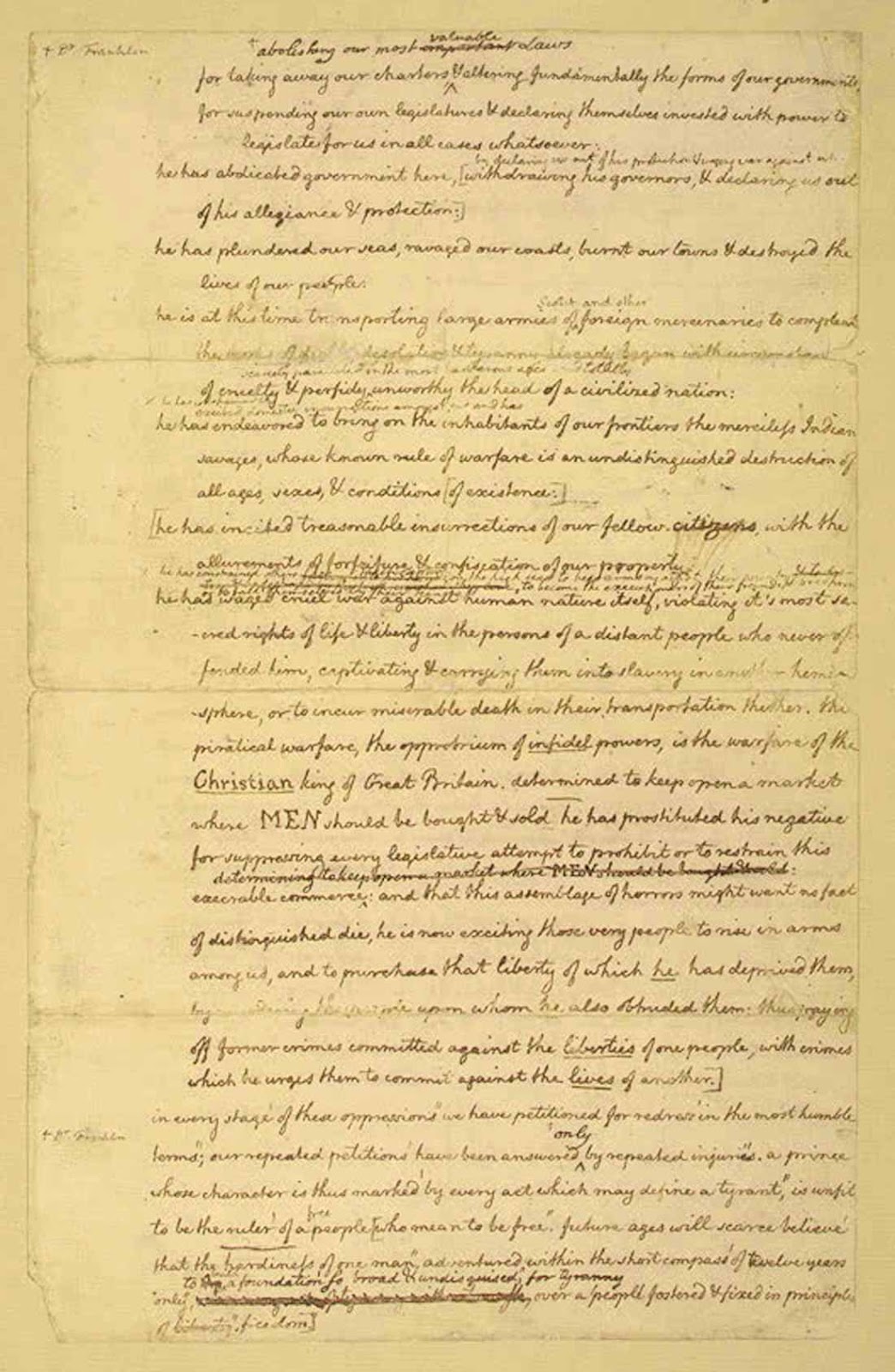
It took two more days for the declaration to be formally adopted by 12 colonies. There were two key points in Jefferson’s original document that some men wanted revised and removed: the first was a critical reference to the English people (fair enough), and the other was his denunciation of slavery and the slave trade. Jefferson's original draft was more humane and true to his fine words above (See Page 3 of the Declaration of Independence below).

Unfortunately, it took another 89 years for slavery to be abolished and for Jefferson’s famous prose of equal rights for all Men to finally be awarded. In addition, it took women until 1920 to be granted a voice and the right to vote. I am digressing, back to the Declaration of Independence. Another two weeks (July 19, 1776)  passed before  the declaration was finally approved by the colony of New York. And on August 2, 1776, it was signed by all the necessary leaders. However, the American War for Independence (the Revolutionary War) would rage on for five more years before the United States would be an independent and free nation (with the signing of the Treaty of Paris with Great Britain in 1783). It is interesting how the date of July 4th on which we commemorate America’s independence is not really indicative of the actual historical truth of our independence, this change took a long time to occur.

Page 1
Page 2
Page 3
Page 4

July 4th is the designated national holiday and is celebrated with fireworks, flags, barbeques, parades and other summertime activities shared with family, friends and the community. On this day we are 185 days into the year and with only 180 left; this is the pinnacle of the summer season. The story of our country at a moment in time (early July, 1776) is an excellent example of the evolution of important ideas, the time it takes to put these into actual practice, and what a democracy and freedom for all really means.

This year, with many forest fires simmering in our area of Colorado, it may not wise to set off sparklers or firecrackers but watching a movie about this period in our history may be another way to enjoy the holiday. Here are three movies that might deepen the experience:


John Adams (HBO TV series) – won 4 Golden Globes and 13 Emmy Awards

Hooper, Tom, dir. John Adams. Perf. Paul Giamatti and LauraLinney. HBO Films, 2008. Film.


The Patriot (Movie/DVD) – nominated for 3 Oscars

Emmerich, Roland, dir. The Patriot. Perf. Mel Gibson and Heath Ledger. Columbia Pictures, 2000. Film.


1776 – (Film version of Broadway musical) 

Hunt, Peter, dir. 1776. Perf.William Daniels and Howard Da Silva. Columbia Pictures, 1972. Film.


References
http://www.constitution.org/tj/tj-orddoi.htm
http://hnn.us/articles/132.html
http://www.history.com/this-day-in-history/american-colonies-declare-independence
http://www.history.com/this-day-in-history/congress-appoints-committee-of-five-to-draft-the-declaration-of-independence
http://www.historyplace.com/unitedstates/revolution/treaty-paris2.htm
http://www.worldatlas.com/webimage/countrys/namerica/usstates/colonies.htm
http://www.history.com/this-day-in-history/house-passes-the-13th-amendment
http://www.ushistory.org/declaration/document/
http://www.imdb.com/
Claude H. Van Tine, The Causes of the War of Independence (1922) p 318


Wednesday, June 27, 2012

Thank You Nora Ephron

 Chinese Phoenix rising from the ashes - Courtesy Google Images

It was back in the 1980s and I needed a location change after the deaths of my mom and of a three-year love affair.  I moved rather hastily to a picturesque little town, Ashland, Oregon, to make a fresh start. The town’s name seemed to imply a good place where fallen phoenixes could arise from their burnt-out selves. Ashland was home to the Oregon Shakespeare Festival and many other "off Bard's way" theatrical productions. It had a nearby ski mountain, a local lake, a lush park, vineyards and colorful Victorian houses -- with all this charm I decided to plop myself there for a spell and enrolled in the local college.  My niece, Gretchen (a psychologist), always said that before one of her patients considers suicide, she suggests they simply try moving to a new place and making a fresh stab at life instead of a bloody stab at one’s heart. I always thought this was sound advice and felt that I was making headway (or heart way).

My friend Pauline lived on a little farmstead or what some call horse property in the nearby town of Talent. One night, in my behalf, she rented the movie, Heartburn, based on a story by writer and humorist Nora Ephron; it was great medicine.  I laughed, I cried, I related, and I no longer felt alone and foolish in my misery. A human can heal amongst the people who have shared the same travails. Misery does indeed love company (and being in the company of Meryl Streep seemed bearable). Nora did more for my broken heart with that story than months of analysis. She made me see the ridiculous humor in the most horrific human shortcomings and offered up a dose of hope. Like the itsy bitsy spider – after being assaulted by the rain she gets up and climbs the water spout again.

Years later Nora Ephron cracked me up again with the story and movie, When Harry Met Sally. Here is a classic film about befriending and being honest with the opposite sex, quite a challenge. And many more years later my granddaughter and I watched the movie, Julie and Julia. We loved the two stories that were intertwined and set around the love of food (and a food icon); we could not wait to get into the kitchen and cook something afterward. And how could we forget her powerful story of Karen Silkwood that was brought to life in the movie Silkwood by Meryl Streep and Cher.

Nora Ephron was so many things: humorist, journalist, writer, screenwriter, playwright, producer, director, award-winner, mother, wife, sister, cook, and to me a woman’s woman. She had a way of being honest about the humanness in all of us and making us laugh aloud at our problems and silly selves, all while whipping up a bowl of Pasta Carbonara. This is something to applaud. Last evening, I found out that Nora had died, and I was so saddened at the loss of this amazing funny woman who could shed laughter and light on so many humans and their foibles. What an enormous loss. In tribute to Ms. Ephron, let’s devour one of her books and delight in watching one of her movies. God be with you Nora and thank you for your gifts!


BOOKS/ESSAYS
Heartburn
Imaginary Friends
Crazy Salad
The Boston Photographs
Scribble Scribble
Wallflower at the Orgy
I Remember Nothing: And other Reflections
I Feel Bad About My Neck: And Other Thoughts on Being a Woman

FILMS  
Silkwood (writer)      
Heartburn (writer, novel)     
When Harry Met Sally... (writer, associate producer)     
Cookie (writer, executive producer) 
My Blue Heaven (writer, executive producer)
This Is My Life (director, writer)
Sleepless in Seattle (director, writer)
Mixed Nuts (director, writer)
Michael (director, writer, producer)
Strike! / The Hairy Bird / All I Wanna Do (executive producer) 
You've Got Mail (director, writer, producer)
Hanging Up (writer, producer)
Lucky Numbers (director, producer)
Bewitched (director, writer, producer)
Julie & Julia (director, writer, producer)


References:
http://www.washingtonpost.com/local/obituaries/nora-ephron-witty-and-award-winning-writer-filmmaker/2012/06/26/gJQAMecW5V_story.html
http://www.nytimes.com/2012/06/27/movies/nora-ephron-essayist-screenwriter-and-director-dies-at-71.html?_r=1&hp
http://www.philly.com/philly/obituaries/160475745.html
http://www.imdb.com/
http://en.wikipedia.org/wiki/Nora_Ephron


Wednesday, June 20, 2012

Sharing recipes, sharing the love.

Sharing Fish by Thomas Cooper Gotch courtesy Wikimedia Commons
There is a unique genetic quality that appears to run in my family, like muscular legs and nice eyes: every blood relative loves to cook—grandmother, mother, sisters, nephew, nieces, daughters, sons, and grand children.  The siblings in my family have often said, “Yeah, our childhood was nuts but the food was awesome.”  My mom grew up on a small farm in northern New Jersey with her immigrant parents and she was raised to be a fabulous cook. There was an intertwining importance that she placed on good food, proper cooking and health, and this “language of love” made an impact that seemed to transfer on to everyone. Furthermore, I was fortunate to have grown up in the same neighborhood as my Home Economics teacher who taught us the simple basics of cooking in 6th through 8th grade. Not only did I have her as a teacher in school but I could observe over many years her strong tradition of cooking for her family from her husband’s garden and preparing the food in traditional nutritious ways.  I was blessed with some great role models. I will never forget in class sautéing thin slices of onions and celery in a little homemade butter with green peas, making “Oriental Peas.” After tasting what was prepared, I started loving vegetables in a way that I never had before. Who knew celery, onions and peas tasted so sweet and yummy together.

When I am feeling a little lost about things in life, my go-to creative place is the kitchen and/or the garden. Pardon the pun but I get grounded outside in the garden and then fulfilled with delicious food in the kitchen.  Another behavior that helps me through any down-in-the-doldrums day is sharing great food with people I love and who love me in return. That said, my niece Vicky and I have been sharing some easy yet delicious recipes lately. One of Vicky’s friends is from Italy and, thus, she has eaten some marvelous food with a great Italian spin at the hands of her friend. She was sharing with me the taste sensation of cooking her friend’s Italian chicken cutlets' recipe and I was drooling just listening to it over the phone. I had to have that recipe—the saliva needed satisfaction. She shared it with me; I was as excited as a dog with a butcher's beef bone. Both Vicky and I cook from the hip, which means to say we sometimes say a handful of this and a pinch or two of that. So forgive me because I had to transfer handfuls and pinches into common measurements when I typed up the recipe to share. I believe it is close to its succulent success.

When my grand-daughter Tay visited on Saturday, we could not wait to fix up this chicken dish. We almost swooned from food passion after consuming these cutlets. What sets them apart, we believe, is the minced fresh garlic and Italian parsley which co-mingles with the bread crumbs and Parmesan cheese to make a very crispy crust on the outside yet maintains a tender moist inside. Without further ado I am sharing the recipe and a few photos of Tay preparing Vicky’s friend's Italian Chicken Cutlets.

Cooking the Italian Chicken Cutlets

ITALIAN CHICKEN CUTLETS
Ingredients
  • ¼ C. peanut oil or a good vegetable oil for sautéing (unless you have an allergy to peanut oil, using it really puts a "crisp" on the chicken and the flavor is divine)
  • 4 range free/hormone free chicken breasts (pounded thin between plastic wrap and sliced into strips)
  • 2-3 eggs beaten with a little milk, salt and pepper (use a large bowl)

  • 1 cup Italian bread crumbs (your favorite brand --make sure they are fresh and not a few years old)
  • 3 T. of flour
  • ½ C. of grated or shredded Parmesan cheese (I think I had freshly shredded on hand)
  • 3-4 T. FRESH Italian Parsley minced fine (use more if you love a hint of green all over)
  • 4-5 cloves of FRESH garlic minced (use more if you love garlic)
Preparation

Soaking chicken tenders in egg mixture


Rinse chicken breasts in water and dry lightly with paper towels. Place one breast at a time between two large pieces of plastic wrap on a flat surface and pound them with a rolling pin until they are of even thinness. You can get some angst out pounding away at chicken breasts. Next, slice the breasts into thin strips about 1 ½ inches wide. Place chicken strips into the bowl containing the egg mixture and let them sit there for about 20 minutes to ½ hour.


Meanwhile, while chicken is taking an egg soak, on cutting board mince up the fresh garlic and parsley. Next, combine garlic and parsley together with the rest of the ingredients (breadcrumbs, Parmesan cheese, and flour) in a wide casserole type container, I used a glass casserole dish. Make sure the garlic, parsley and cheese are spread evenly throughout breadcrumb mixture which will coat the chicken strips.

Dip egg soaked chicken into breadcrumb/cheese/garlic mixture

Here is the fun messy part. Take a few strips of chicken out of the egg mixture and roll them around in the breadcrumb/cheese garlic mixture and set aside until all pieces are well coated (see photo above). Heat the oil in a large frying pan on medium/high heat until a drop of water skitters across the pan and sizzles. Fry about 4-5 chicken strips at a time (this keeps the oil at a good high temperature) for about 3 minutes per side (the length of time depends on your stove -- my gas range transfers heat differently than an electric range).
Sauteing until golden brown and crispy
Transfer the cooked strips onto a cookie sheet and place in a 250 degree oven to keep warm until all of the chicken is cooked. Look for a golden crisp crust on outside but still moist and tender inside. The chicken will continue cooking in oven. Do not overcook! We served them with fluffy mashed Yukon Gold potatoes and fresh carrots. Too die for delicious!
Seconds anyone? Nope they did not last - yummy
I guess Pillsbury was right with their slogan "nothin' says lovin' like something from the oven."


Monday, June 4, 2012

June is a Rosey Time

My Zephirine Drouhin - she is a sweetie
A sepal, petal, and a thorn
Upon a common summer's morn—
A flask of Dew—A Bee or two—
A Breeze—a caper in the trees—
And I am a Rose!
- by Emily Dickinson

 
My sister adores Emily Dickinson but abhors roses. I certainly can understand why some people might not want to lovingly embrace this flowering plant. Roses can be beautiful with their intoxicating fragrance and velvet-like petals in copious colors and edible seed pods (rose hips) rich in Vitamin C; but with sharp sickle-shaped prickles aligning their canes, they can be quite uncomfortable to be around. They are like that handsome yet unapproachable person you had a crush on in college—every time you tried to get near that person you were stung by their cruelty.

Since roses do need to be pruned (removing old blackened canes to inspire newer growth), handling their thorny branches can be about as much fun as sticking pins in oneself.  In addition, the ubiquitous hybrid tea roses are very “high maintenance;” like a spoiled fairy princess, they require constant attention (deadheading, fertilizing and debugging). This much work for a pretty bud just doesn’t appeal to me. So I get that some people just don’t go for roses. What if we could have the beauty without the bane?

Some years ago I worked for a large rose company, and since I enjoyed learning about all things botanical, I spent my time there absorbing the good, bad and ugly of the genus Rosa. I fell in love with hardier roses—roses that are on their own root stock and survive with a minimal amount of fuss or bother. Many antique and heirloom roses fit this description. I also learned there are exceptions to most rules in the world of flora—not all roses have thorns. There is a rose that offers hefty hardiness along with ever-blooming beauty, powerful perfume, and the pièce de résistance—it is thornless! The name of this rose is “Zephirine Drouhin,” a “Bourbon” rose that traces its origin to France in 1868. It is a lovely deep pink and can climb up to 12 ft. You can safely get close to this one without getting hurt and you will swoon over its perfume.  Bourbon roses are rumored to be a cross between an “Old Blush” China rose and the "Autumn Damask."  The hybridization brought together the cold-hardiness and repeat-blooming of the Chinese rose with the strong fragrance of the rangy Damask rose. It was a good marriage.

After growing many roses in my western garden I found a few thornless roses you may want to try along with a little trick of the trade.  If your roses do succumb to the common blackspot fungus or powdery mildew (usually due to sprinkler systems rather than high humidity), try this safe inexpensive remedy:
Zephirine Drouhin on June 1

Blackspot Recipe:
1 quart of water
1 Tablespoon of baking soda 
2-3 drops of dish soap

Mix well and spray on the leaves. The fungus does not like the alkaline environment created by the baking soda—the dish soap helps the formula stick to the foliage.

A list of my favorite thornless roses below:

  • Cecile Brunner - another antique (1881) rose; it is a vigorous climber with a multitude of small light pink blooms.
  • Goldfinch - a buttery yellow abundant bloomer, flowering in late spring/early summer. 
  • Mme. Plantier - an Alba rose with a peachy-white double bloom.
  • Mme. Legras de St. Germain - a pure white and very fragrant Alba rose reminiscent of a camellia.
  • Zephirine Drouhin - see above.

Colorado, with its ubiquitous sunshine and dry climate, is great for growing roses and one can find wild roses blooming along the banks of Cherry Creek and the High Line Canal right now. If prickles (or what most folks call thorns) were keeping you away from roses, try a “thornless” rose.  They are exceptionally easier to love.


References:

http://www.heirloomroses.com/care/thornless-roses/
http://www.davidaustinroses.com/english/Showrose.asp?Showr=619

http://www.missouribotanicalgarden.org/gardens-gardening/your-garden/plant-finder/plant-details/kc/w510/rosa-z%C3%A9phirine-drouhin.aspx

http://www.jacksonandperkins.com/zephirine-drouhin-antique-climbing-rose/p/39970/

http://www.ces.ncsu.edu/depts/hort/consumer/factsheets/roses/zephirinedrouhin.htm
 
http://en.wikipedia.org/wiki/Garden_roses

Wednesday, May 23, 2012

The Greening of the Denver Zoo and their Toyota Elephant Passage

Sneak peak: Two Asian Elephants @ Toyota Elephant Passage
Picture this…It is somewhere in Southeast Asia, perhaps Thailand or Sri Lanka.  Lying among the grasses is an enormous gray mass. An Asian Elephant has been killed; an elderly woman stands near the animal sobbing into a handkerchief.  It is a sad day and there are conflicting emotions. The elephant was encroaching on a human settlement by crop-raiding, because the animal was a threat to human safety, she was shot.  Yet, who doesn’t love an elephant? Ever since indulging in the childhood stories of Babar, the Disney movie Dumbo, or more recently, the movie Water for Elephants, and loving Ganesh (the elephant-headed man and remover of obstacles) from Hindi philosophy, elephants trample deeply into our hearts.


Ganesh - remover of obstacles
 
Asian elephants were once highly revered in Southeast Asian cultures; they were often domesticated and used as workers in the logging industry and they had a close bond to their trainer/caretakers (called mahouts). But the ever-expanding human populations and their demands for resources throughout the world have continuously reduced the natural habitat areas for wild animals. And this is true for the Asian elephant (Elephas maximus).  Conflicts arise when a hungry elephant raids the croplands grown for human consumption.  Many countries of the Pacific Rim and Southeast Asia (and elsewhere around the globe) are trying to find solutions to preserving and protecting the indigenous animals that once roamed freely. Now many indigenous free-roaming animals are forced to go hungry. What is a solution that would protect and preserve animals that do not have enough natural habitat areas to forage for food and are thus forced into human-populated regions? Enter the wildlife preserves and committed zoos that work to keep endangered animals and humans safe from such conflicts.

Our own local Denver Zoo reaches out to other countries throughout the world to preserve and protect wild animals. The zoo has spent over $1 million to support animal conservation, and since 1996 has participated in 568 projects in 57 countries. With the new Asian Tropics exhibit, called the Toyota Elephant Passage, it is concentrating on the animals of Southeast Asia and the Pacific Rim. Not only is the new Toyota Elephant Passage the largest elephant facility in the country, able to house 8 bull elephants and several females within the 10-acre range, it also will provide a home for other Asian species such as Greater one-horned Rhinoceros, Malayan tapirs, Sarus cranes, Clouded leopards, White-cheeked gibbons, and Asian Small-clawed Otters. The new area will offer just what the title implies, “a passage” for the animals to wander safely throughout the area within cabled corridors. These fenced pathways will provide exercise and encourage more natural behaviors for the larger species.

Inside exhibit showing great use of natural light
Furthermore, The Denver Zoo accomplishes this feat of caretaking and conservation of endangered species by being extremely “green” – eat your heart out, Kermit. The state-of-the-art innovations implemented at the Toyota Elephant Passage have made the Denver Zoo the greenest zoo in the country.  The Denver Zoo is set to receive Gold (or Platinum) LEED’s Certification and the ISO 14001 certification for incorporating the highest environmental standards for their operation. These achievements have been accomplished by utilizing several resourceful methods:  incorporating a Biomass Gasification system which recycles 1.5 million pounds of animal and human waste created annually into energy, a water filtration system that will recycle the 1.1 million gallons of water used in the man-made ponds, sustainable architectural design and construction choices that use natural light (skylights, Solatubes, and reflection systems,) and ventilation systems that improve air quality.

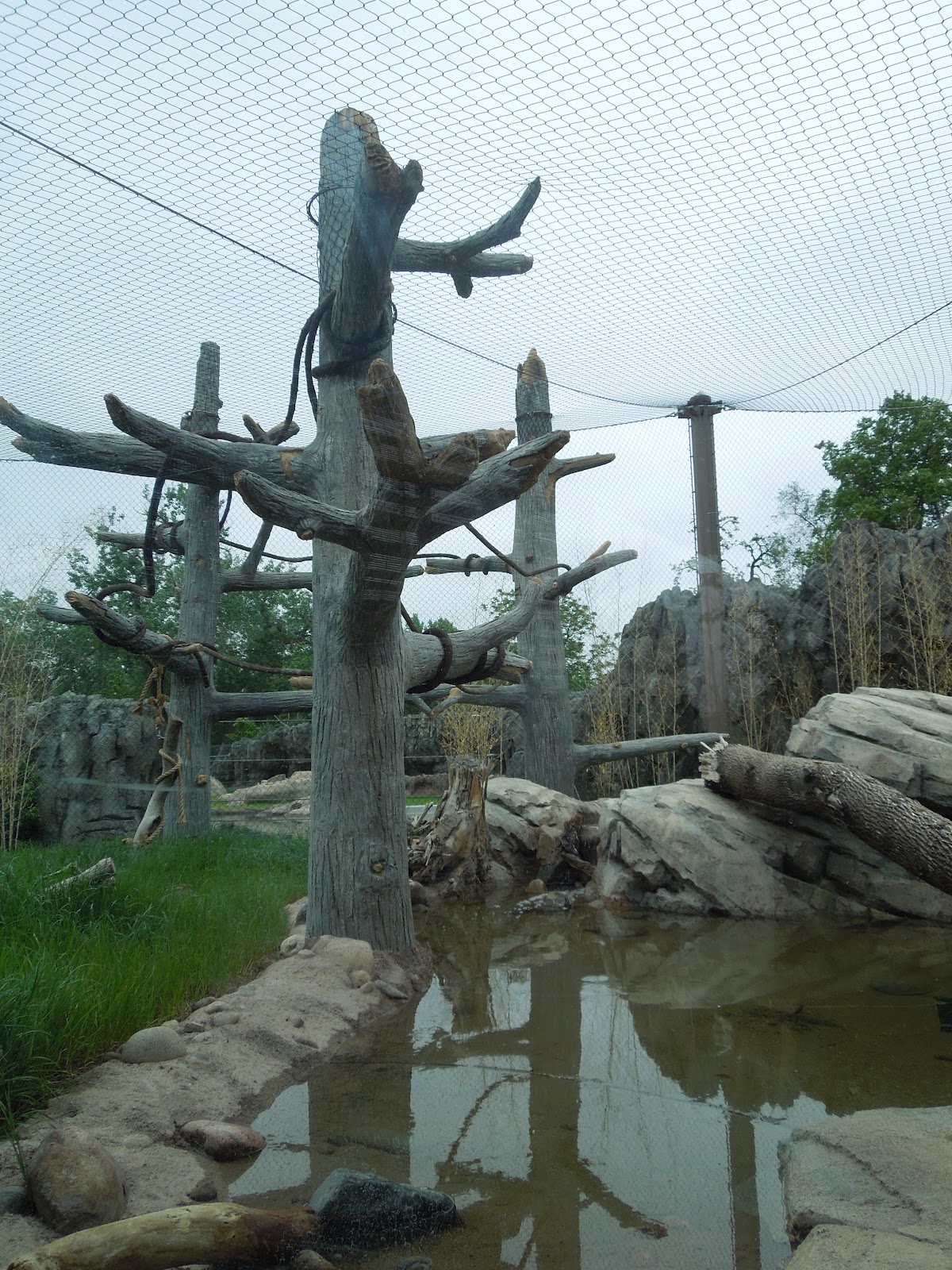
A Gibbon playground

This 10-acre zoo addition is divided into three main sections: Chang Pa Wildlife Preserve, which mimics a wildlife reserve in an Asian country; Scholzel Family Village, complete with prayer flags blowing in the wind and Buddhist prayer wheels, and the Village Outpost, which exhibits some of the travails of wild animals having to deal with human settlements.

All this is made possible with a little help from their friends. The Denver  Zoo worked with the National Renewable Energy Lab (NREL) during the early phases of development to explore viable energy options.  Other financial supporters were Encana Oil & Gas (USA) Inc., The Boettcher Foundation, Anabel C. and Jerome P. McHugh, The Governor’s Energy Office (Colorado), Pioneer Resources, Mesa Energy Partners, LLC and Western Energy Alliance.  However, we must sing praises to the namesake of the elephant passage, the group that continues to support the exhibition—Denver Toyota Dealers Association.  Their funds and support are making this animal and Asian cultural adventure deliver. This is no small feat. When a highly-visible organization such as the Denver Zoo sets the bar as the best of all the rest in environmental practices, it paves the way for others to follow (such as our local Toyota dealers) and make being green a beautiful thing. Thank you all!
Thanks to:
Groove Toyota in Englewood, Mountain States Toyota
in Denver, Stapp Interstate Toyota in Frederick, Stevinson Toyota East in Aurora, Stevinson
Toyota West in Lakewood, Larry H. Miller Toyota in Boulder and Go Toyota in Centennial.


References
http://www.denverzoo.org/toyota_elephant_passage/about_the_project/animals/index.html#Elephant