Sunday, March 17, 2013

Georgia on my mind


Georgia OKeeffe, 1920, by Alfred Stieglitz,
Objective painting is not good painting unless it is good in the abstract sense. A hill or tree cannot make a good painting just because it is a hill or tree. It is lines and colors put together so that they may say something. ~ Georgia O'Keeffe

While Bumble and I are not terribly dogmatic about our lives, we do stay faithful to a few lofty goals: embrace organic growing practices and eat healthy, go outside and exercise daily, read and learn something new, and once a month attend a cultural event. A cultural event can include such treasures as a theater performance, lecture, live musical event, gallery visit, local festival, or museum exhibition. Yesterday, in the middle of March, we chose to partake in the latter. We went to the Denver Art Museum’s (DAM) exhibition titled “Georgia O’Keeffe in New Mexico: Architecture, Katsinam, and the Land.”

“Katsinam,” I wondered, “what exactly is that?”

"Blue-headed Indian Doll" by Georgia O'Keeffe
 Photo courtesy DAM
While I knew it had something to do with the native cultures of the southwest, I quickly learned from the exhibition that “katsinam” are the carved and painted representations of Hopi and Pueblo "spirit beings" often called katsinas or kachinas. They are otherworldly doll-like figures carved from cottonwood, brilliantly painted and adorned. They can be spiritual representations of anything in the natural world—an ancestor, a concept, a phenomenon, a place—the sun, stars, storms, corn, insects, etc. Katsinam represent the presence of a life force in all things. Aside from painting the animal bones and western landscapes of her beloved New Mexico, Georgia O’Keeffe also painted the colorful katsinam; I can see how the shapes and colors intrigued her. I never saw her katsinam paintings until yesterday. Before the exhibit of O'Keeffe's katsinam paintings and drawings, there were respect issues to be addressed with the Hopi nation as to who should even be allowed to depict the katsinam, which is why viewing her impressions of them was a rare treat.

"Rust Red Hills" by Georgia O'Keeffee
The exhibit deepened one’s understanding of this folk art by also including a DAM collection of katsinam carved by various Native American artists. Shown too are several paintings by Dan Haminga, two stunning and graphic weavings by Ramona Sakiestewa and a huge painting by David Bradley depicting Georgia O’Keeffe as Whistler’s mother, all of which added to the experience. A small section of the exhibit broadcast a documentary movie of Georgia O’Keeffe continually; you could hear her voice and see her absorbed in the landscape.


"The Mountain" by Georgia O'Keeffe

What is it about seeing the artwork of the great painters, sculptors, carvers, or weavers? Why do we gawk at art? What is it about this experience? For me, it is a chance to marvel at the creative process. To share in the artist's vision of a place or a thing. It is always inspiring to view the museum's many exhibits (from Van Gogh to Matisse to O’Keeffe) and observe up-close the brush strokes of the artists, the colors, the mood, and the visions they saw. Seeing the work of Georgia O’Keeffe, who is as iconic an American genius as Frank Lloyd Wright is to me, was a special opportunity to admire the work of a woman who brings to life the way I emotionally experience the landscapes of the southwest.  For me, nature is a place of worship, an entity with incredible life force, just like the katsinam represent.

There I was studying one of her paintings titled “The Mountain”— marveling as her varied brush strokes, her mastery of blending paint, her vision, her subject matter, her color palette, her eye, her steady hand, her everything—and it happened. The painting started to move. It was as if I had been slipped a psychedelic mind-altering drug; it was coming alive with energy, wriggling shapes, and colors. It was at that moment, I knew I was in the presence of greatness. Part American history, part indigenous culture, part modernism, part of our West, part homage to the contributions of a great woman; it was a DAM good experience.


References
http://siarchives.si.edu/blog/art-message
http://www.denverartmuseum.org/
http://www.denverartmuseum.org/exhibitions/georgia-okeeffe-new-mexico
http://www.okeeffemuseum.org/upcoming-exhibitions.html
http://www.westword.com/2013-03-14/culture/georgia-okeeffe-denver-art-museum-review/
http://kachina.us/
http://en.wikipedia.org/wiki/Kachina


Thursday, February 14, 2013

Valentine’s Day: Hoopla or Hope?


SONNET 116               
Let me not to the marriage of true minds
Admit impediments. Love is not love
Which alters when it alteration finds,
Or bends with the remover to remove:
O no! it is an ever-fixed mark
That looks on tempests and is never shaken;
It is the star to every wandering bark,
Whose worth's unknown, although his height be taken.
Love's not Time's fool, though rosy lips and cheeks
Within his bending sickle's compass come:
Love alters not with his brief hours and weeks,
But bears it out even to the edge of doom.
   If this be error and upon me proved,
   I never writ, nor no man ever loved. 

 ~by William  Shakespeare


Although I am not a romantic person who requires presents, cards or flowers to feel loved (however, chocolate is an exception and quite appreciated) I must say I do like the heart-full celebration of this day. I believe celebrating love is a good thing, albeit Valentine’s Day has been romanticized and commercialized tremendously by retailers everywhere, I would rather hold on to the whole cultural concept instead of doing away with it. And I would like this day to focus on all variations of love—brotherly love, maternal and paternal love, unconditional love, spiritual love, same-sex love, animal love, platonic love, self love—beyond the romantic.  They’re all vital—love is love.

What could be the harm in a day which lifts our spirits during February’s doldrums with splashes of bright red hearts posted around town? I love red and seeing hearts and roses on display is uplifting. Ah, and chocolate the divine elixir can deliciously brighten any moment. Not to forget, the little four-letter word “love” written thousands of times on greeting cards and posters with its inspired meanings and range of feelings. I hope humans forever keep this word and its meaning in their emotional handbag and offer it up often. Love or loving does not guarantee anything—you just do it. One must “bear it out even to the edge of doom” and hold it without any promise. And if love does not work out well in the end one must attempt holding the feeling in reverence but letting go the object. It is one of those tasks we are here to master I am afraid. 

I read a blog post this morning begging the question: what are my favorite books about love? Immediately, two books came to my mind “Jane Eyre” by Charlotte Brontë and “Anna Karenina” by Leo Tolstoy. Each book addresses the suffering and pain of love—one story ends beautifully and the other tragically. I hope this does not imply that great love stories only existed in past centuries, but simply that these were just deeply embedded in my memory. Both stories have been made into wonderful films (many times over) and are worth watching. I enjoyed the latest remake (2012) of Anna Karenina with Keira Knightly, but there are earlier versions -- (1935) featuring Greta Garbo and (1948) with Vivien Leigh -- which are excellent. My favorite version of Jane Eyre is performed by Charlotte Gainsbourg (1996) and takes my breath away, but the 1943 version with Joan Fontaine is quite moving. What are your favorite books (or movies) of love?

Finally, a big kiss and hug to Bumble, my husband, who woke with me last night when a migraine headache had me reeling with pain and tried to assist. I hope for everyone on Valentine's Day to have this kind of loving bond.

References
http://www.shakespeares-sonnets.com/sonnet/116
http://www.imdb.com/

Tuesday, December 4, 2012

Emergence


(Photo: crazy quilt of my life and travels)

“The whole is greater than the sum of its parts.” ~ Aristotle

Amidst the laws of nature in the scientific field of study called “complexity” (termed the “science of the 21st Century” by Stephen Hawking) is the phenomenon of emergence.  Emergence can be explained as complex patterns and behaviors arising from simple parts combined in various ways. It is the innovative combination and recombination of simple building blocks which become more complex than the original entity. Examples familiar to many would be flocks of birds or schools of fish moving as one organism in graceful yet random patterns; ant colonies consisting of individual ants, each with simple tasks, together creating organized and complex habitats; global metropolitan cities with ever changing demographics; the stock market with its complex unpredictability and organized chaos; hurricanes devastating coastline communities or fizzling over the ocean; complex computer technology developing from a simple language of “0” and “1”;  and atoms combining into a molecule (i.e., hydrogen and oxygen becoming water) possessing amazing properties unlike either atom.  Also, unlike an organization of individuals that has a leader at the top—like the conductor of an orchestra or a general in a battle—emergence systems operate from the bottom up. No one bird in a flock or fish in a school guides the group, although there appears to be a few rules they do follow—keep going the same direction, don't get too close or too far, and get out of the way of danger. The individuals can adapt, evolve, encourage and reorganize ever-increasing diversity and complexity in patterns and behavior. If this subject fascinates you as much as it does me, there is a book written by John Holland, a professor of psychology as well as computer science and engineering at the University of Michigan, titled Emergence: From Chaos to Order that may be worth your time.


I ponder the concept of emergence in relationship to food and art. Put five or six common ingredients together (butter, flour, cream cheese, eggs, vanilla, and sugar), bake for one hour and you have created a cheesecake worthy of rave. Add together random strokes, splatters or drips of various paint colors on a canvas and it could be as exciting as a Jackson Pollock. Combine small scraps of colored fabric (which in and of themselves are too small to have a purpose) and sewn together, they become a quilt offering warmth, cover and design.  The many combinations in patchwork (piecing fabrics together) are mathematical and magical. From random crazy quilts to geometric Amish designs (such as square within a square) the concept of emergence is made evident.  A quilter can take a simple square and recombine it in so many variations and colors that it defies its original simplicity. It becomes quite complex, and I love that.

My Amish style quilt of simple squares and rectangles

Recently, I acquired bags of fabric scraps at a textile fair (Tactile Textile Arts Center) and was inspired to create something useful. Design ideas began emerging from simple squares and rectangles, it was plain fun! Researching on the internet for patchwork patterns, I discovered five wonderful blogs/websites that were inspirational in helping me. In the interest of sharing here they are:

  • Mama Love Quilts – Nicole is a brilliant textile artist! I am in awe of her creativity and color sense.
  • Quilt Story – Two sisters, Heather and Meagan, share their creations in a homey welcoming way.
  • Fave Quilts – a website dictionary of designs and ideas for quilters.
  • Quiltville – Bonnie is a master at putting scraps together and making do!
  • Piecemeal Quilts – Sandi finds the art of cutting up fabric into little pieces and then recombining them a joy.  
  •  
Botanically inspired fabric squares sewn into a simple quilt.

On an emotional level, I find a heartwarming metaphor of emergence woven into each human being similar to the craft of patchwork quilting.  Random pieces and parts of ourselves (both colorful and plain) can combine into complex more creative aspects of ourselves and something more useful. The human brain contains billions of neurons and each individual neuron connects with 10,000 other neurons; this makes for incredible complexity. Interestingly, a computer element generally only has contact with 10 other elements. It is possible that human consciousness arose from the complexity of these neuron interactions, where no single neuron is in charge. I believe we all are a complex patchwork of the Universe’s purpose. Truly, our whole is greater than the sum of our parts.


References
http://quotationsbook.com/quote/47821/
http://www.pbs.org/wgbh/nova/nature/emergence.html
http://serendip.brynmawr.edu/complexity/models/antcolonies/page2.html
http://en.wikipedia.org/wiki/Emergence
http://www.technologyreview.com/view/427856/the-single-theory-that-could-explain-emergence-organisation-and-the-origin-of-life/
http://www.princeton.edu/~achaney/tmve/wiki100k/docs/Autocatalytic_set.html
Holland, John. Emergence: From Chaos to Order. Paperback. Cambridge, Mass.: Perseus Books, 1998. Print. 


Quilting websites and blogs
http://mamalovequilts.blogspot.com/
http://piecemealquilts.wordpress.com
http://quiltville.blogspot.com/
http://www.favequilts.com/
http://quiltstory.blogspot.com/


Thursday, November 29, 2012

The Liebster Award 2012

Last year I began blogging. Over 181 million other humans are doing it and it is easy. One does not need anyone’s permission or a license or a publisher or a certification or degree or any money, for that matter— just a keyboard and a simple blog platform and, presto, one can begin writing and self-publishing. It is the ultimate form of democratic freedom—to have a voice and put it out into the universe unhindered. With a free blogging platform, a simple soul can share with the universe anything she (or he) desires—from books to recipes, joys or sorrows, memories or haunts, along with beautiful pictures and photos. It is as joyful as journaling, wrapping oneself in thoughts or ideas and watching them taking shape—fingers pressing pencil to pad, or in my world, letter keys producing typeface onto a computer screen. Thoughts come spelling out as words, sentences and paragraphs. I only had the tiniest, most microscopic, little itsy-bitsy agenda: to share—soft gentle things that I have gleaned worthy over the course of my life in the context of the place where I live. Things such as healthy food and recipes, positive growth and organic gardening, hobbies and recreation, places visited, movies, stories, reflections and hope. A middle-aged woman sharing simple mundane things laced with a little lesson or piece of information. But my enthusiasm began to wane after a year when I compared my blog to other seasoned bloggers who were more clever, more artistic, making money advertising, and had a following—an actual readership. Bumble always says, "Nothing is true by comparison." Yet I knew I was terribly green and not in an good environmental way but in a amateurish "need to get my act together" way. So my posts became fewer and I did not feel that I measured up. Like any living thing in the earth's ecosystem, in order to survive I needed to find my niche.

Yesterday, Arti from Ripple Effects tagged me in regards to the Liebster Award. It is an award for new bloggers that do not have a huge following (under 200) and, yes, that would be me. I have two followers, one being my husband, Bumble, and the other must be Arti from Ripple Effects. Someone actually read my posts and felt something. A connection was born. Having a mom of German decent, I quickly assumed Liebster meant favorite or beloved or sweetheart and indeed it does in the case of the Liebster Award. In the spirit of the Liebster Award, a person's blog that was tagged for the award must in turn tag other blogs, like a chain letter. And like any chain letter where one hopes to receive a special blessing, here is what people tagged for the Liebster Award are supposed to do: First post 11 facts about yourself, then answer the questions the nominator made for you (Arti proposed 7 questions). Next, you create new questions for the bloggers you nominate if you want. Then you choose fledgling blogs to nominate, and be sure to link them to your post. 

11 Facts about me

  1. I was ostracized and treated terribly in middle school and to this day I am a loner wary of humans.
  2. My first love was dogs, second love was horses, third love was snow skiing. . .
  3. My grandfather, John, was an illegal immigrant (he was a stowaway on a ship from Scotland).
  4. My mom once told me if you want to be happily married, then marry a Jewish man. I finally listened.
  5. Nature is my church or synagogue, I go there to meditate and pray.
  6. My 2nd marriage taught me what love really means.
  7. I have a terrible time remembering people’s names, yet I can hear a voice (or song) and identify the owner. 
  8. I love education, but after my long devotion to it, never landed the job of my dreams.
  9. I was unwed and pregnant at 15 years old and a mother of a baby girl at 16 years old.
  10. Parenting is the hardest job you will ever do, and grand parenting is easy.
  11. I believe in karma, I cannot make a mistake without the lessons bashing me over the head immediately.
Now, my answers to the 7 questions that Arti from Ripple Effects posted for us:

1. What do you think of literary prizes? Good idea or bad?

Good idea. When I was studying library and information science, I learned there must be a certain set of criteria in which to evaluate a book, resource, or piece of information to determine whether it is credible, reliable or just plain good. Questions must be asked: Who is the author, what is his/her reputation, who is the publisher, what are their credentials and affiliations, if scientific is it current and timely, has the piece been acknowledged, nominated or the winner of any literary award from a scholarly group of peers? From a Pulitzer Prize to a Newberry Medal, a book or article that has received such recognition does seem have merit. Yet I must say with regard to the fable The Emperor’s New Clothes that just because a certain intellectual group believes something is there doesn’t always make it necessarily true.

2. If you could write any sort of book, what would you write?

A group of short story memoirs thinly disguised as fiction interwoven with nature’s ecological principles.

3. Describe your ideal home library/study.

A fireplace or Franklin stove anchoring the room, a large L-shaped contemporary desk complete with computer and printer, books and resources spilling out of built-in bookshelves, a colorful globe, plants, old worn leather chairs, good lighting and a window, filing cabinets, inspiring artwork and pictures, an additional space in a corner for my sewing machine and textiles, my cat and my husband.

4. Name two new authors whose work you think will last the test of time, and explain your choices.

Cheryl Strayed, because her prose is filled with ballsy honest raw human emotions. More humans should be this brave about what is going on inside them, we would have more genuine connections. Read:  Wild: From Lost to Found on the Pacific Crest Trail or Torch.

Sharman Apt Russell, because she writes about nature with such elegance that you see it again in a new light. Her deep research is a librarian’s dream. Read:  An Obsession with Butterflies: Our Long Love Affair with a Singular Insect or Anatomy of a Rose: Exploring the Secret Life of Flowers.

5. Which books do you hope to get for Christmas?

I do enjoy those big heavy coffee table books filled with photos that I cannot afford. One on my list would be: Rare Bird of Fashion: The Irreverent Iris Apfel by Eric Boman. Iris Apfel makes being herself and dressing in her amazing wardrobe the best art form of all—being living art.

6. What’s the last book you did not finish and why?

And I Shall Have Some Peace There: Trading in the Fast Lane for My Own Dirt Road
by Margaret Roach.

Margaret Roach is a devoted and brilliantly self-educated gardener. I could not wait to glean knowledge from a kindred spirit. I am a master gardener with 25 years of experience, an MS degree in environmental studies, and have spent many years working in the horticultural field never choosing the corporate fast lane. However, midway through the book (even though some of the prose was lovely) I was not grasping the point and became disappointed with the self-possessed rambling. It was not a biological or emotional learning experience for me. I believe the author was blessed to have this book published because of her connection to Martha Stewart and her enterprise. I wish I had connections, but alas I am wary of humans (see fun facts #1).

7. Would you accept 20 books that were absolutely perfect for you and dependably brilliant reads, if they were also the last 20 books you could ever acquire?

Well, if you mean by “acquire” that they would be mine to keep, does that mean I could still go to the library and borrow and read as many books as my card will allow for the rest of my life as long as I technically did not acquire them? If I could still read library books, then perhaps yes, I would be awfully curious to see the 20 books that were absolutely perfect for me. I am a curious animal like my cat.

OK, now to tag other new bloggers (with less than 200 followers) for the Liebster Award. I only know of one fairly new blogger: http://nomading.tumblr.com/  by Melinda S. (Her last name is withheld until she gives me permission to post it).  I love her writing and adventures, and like me, she does not advertise her blog on FB or any other social media that I am aware. I invite her to answer the 7 questions that Arti posted for me and, of course, share her 11 fun facts.  Good luck to everyone and may the chain of blessings begin.


References:
http://www.dazeinfo.com/2012/03/10/number-of-blogs-up-from-35-million-in-2006-to-181-million-by-the-end-of-2011/  (sourcing information from NM Incite)

Wednesday, November 21, 2012

Thanks giving

Lately, especially during long walks on crisp sunny Colorado mornings, I realize how fortunate I am and I say it out loud thank you Universe, thank you God.  I offer up my gratitude for being a very lucky women:  I have a kind husband who is my dearest friend, a little backyard garden that produces organic food, children who are grown and healthy and offering the world great services, a sturdy mid-century modern home that is almost paid for, a solid college education that helps me understand the ways of the world, a strong body that keeps going without injury, and rocket bombs are not raining over my head. I am very grateful.  Of course, there were many years in my life when things were not so good:  when I wasn’t married to my best friend but an enemy, when I lost a home I helped create to my ex-husband’s gambling debts, when I was worried how to feed my children and whether the divorce scarred them for life, and often I wondered if I would ever find love again. There is a line in the book and movie “Out of Africa” written by Isak Dinesen (aka Karen Christenze Blixen) that goes like this: God made the world round so we would never be able to see too far down the road. Sometimes in life we do not know the good (or the bad) that may befall us in our future. 

The holidays have arrived and I do love to prepare food—heart-warming healthy food. It feels satisfying and well, it just feels like love. And I do this job pretty much 330 days a year (I rely on leftovers to fill in for the other days). Yet, I must say, after preparing Thanksgiving Dinner for four decades—preparing the large tedious turkey dinner with more side dishes than a hooker has high heels—it no longer excites. Rather, it depletes me and the monthly budget, and adds a bit of stress (what size turkey should I get this year, who has the best free-range birds, how many bags of fresh cranberries do I need, how many vegetable casseroles is enough, will the gravy turn out, pumpkin pie or apple or both, what if I don’t have enough funds in my bank account, how many will I feed, on and on). Sometimes I wonder why women often do not get a holiday on a holiday. They are busy working in the kitchen making holiday happen for their family or loved ones. Rituals are lovely and very important, but for those who create them they can be tedious. Maybe there should be a new ritual that a woman who prepares Thanksgiving dinner at her home one year must not be a allowed to do it again for another 5 years—it must be passed around to others before it comes back to roost. Or perhaps after a certain age we just pass the whole mess on to the younger set. I could get behind this wholeheartedly.

Truth be known, I am really not that crazy about turkey. It is fairly high-maintenance poultry to prepare—it requires brining, basting or cooking upside down for a few hours, and even enveloping in some space-age clear bag. Upon consumption, turkey triggers a L-tryptophan reaction leaving one resembling the smokers in a hazy opium den. Perhaps, the football results may further add to the guest's depression. On the other hand, I do adore the mashed sweet potatoes, moist stuffing and pumpkin pie, but not the awful over-eating we all are guilty of on this day.  And let’s not forget the grueling clean-up—the challenge of finding the right size plastic container to store the leftovers in the fridge hoping everything fits, and the never ending scrubbing of casserole dishes, pots and pans.  I cannot imagine what is must have been like for my mom (or her mom’s generation). These women did not have the helping hand of an electric dishwasher which super cleans all our plates, glasses, goblets and silverware with ease.  Another reason for us to be thankful.

I wonder what stuffing a turkey and ourselves has to do with expressing gratitude. Is it the ritual of breaking bread with family and friends? Perhaps it is the gift of the cook to the family—saying here is my enormous spread, come partake and make your selves sick with gluttony and me with exhaustion—that we should be grateful for along with the bountiful gifts that nature (and the food industry) provides us. I suppose I am just questioning things more now. Why do we have to do this every year (in addition to the big Christmas/Chanukah celebration) because our cultural history requires us to? Earlier in my life I was just so dang eager to please, be a good mom, and feed people. Why can’t we take an occasional sabbatical from the rituals? Seriously would the sun not come out tomorrow? Would the Thanksgiving police show up at the door?

I can conjure up only one positive to preparing the big dinner—good old leftovers. Those leftovers finally pay off for all the work up front—all the planning, shopping, washing, preparing, chopping, cutting, sauteing, mashing, whipping, rolling, baking, serving and finally cleaning up. All I had to do after Thursday ended was throw together a hot turkey sandwich with cranberries and gravy for the next few days.  That was the leftover blessing.  Yum.

I hope everyone enjoys a great Thanksgiving this year and finds good reasons to be grateful. I hope you express gratitude for the cook/s (even if the dinner turns out slightly different from a Norman Rockwell painting). Lastly, if you really don’t feel up to it maybe this year you can take a break and go to a little French restaurant for Thanksgiving instead of hosting the whole affair at home. To be sure, I have witnessed some very happy unstressed people breaking bread at a great local French restaurant in Denver. The cost was less than what one spends at the grocery store and you probably would not miss the preparation and clean-up either. You may miss the leftovers but it would be a good trade. And I promise the sun will come out the next day. 

References
http://www.goodreads.com/author/quotes/8147.Karen_Blixen
http://office.microsoft.com/en-us/images/results.aspx?qu=turkey%20bird&ex=2#ai:MC900337890|
http://chemistry.about.com/od/holidaysseasons/a/tiredturkey.htm

Tuesday, September 4, 2012

Ambivalence over the harvest

My peaches from the harvest
September is upon us and today, the day I am writing this, is Labor Day.  Bumble is enjoying the day off and he comes into the computer room where I am typing and says, “Close your eyes and open your mouth.”  I do just that. And in an instant I recognize the sweetness coming from the pubescent and globular textures of fresh raspberries he has picked from our baby bush and dropped upon my tongue.  Glorious burst of what magenta would probably taste like.

It has been a very long hot summer in Denver. Right now I can barely keep up with using the ripened fruits, tomatoes, cucumbers and eggplants. Yes, another ratatouille dish and my old cucumber and vinegar salad for dinner.  For me, harvest time comes with a tremendous ambivalence. On one hand it is a blessing I am very grateful for—all the bounty that has manifested from the fruits of our gardening labor— sometimes more than we can use readily. I barely need to visit the grocery store these days and we are eating many more helpings of vegetables and fruits every day. Yet on the other hand, harvest time marks the end of the grand growing season, and I know that one day, when the last eggplant, cucumber or tomato is consumed, there will be no more. No more organically-grown vegetables and fruits from this tiny piece of land until next year.  There is a sadness that comes over me.  I know that this creative process of watching food grow and mature and fill one’s stomach will cease for a few months.

Cucumbers, zucchinis, onions harvested


Canning and pickling is a wonderful way to extend the gifts from the garden ‘tis true, but the canning process makes for a hot and sweaty kitchen.  Freezing a few items for later on is easy. I freeze my basil leaves in tiny sandwich bags, first rinsing and drying the leaves and then divvying up the leaves into several ziplock bags. I make sure to squash out any air in the bag to avoid freezer burn. They store like flat envelopes in my freezer. Later I unzip a bag of frozen leaves and crumble them with my hands before they land gently in my tomato sauce. They are as green as the day they were picked and almost as fragrant.

Peaches on pancakes

Generally Bumble and I consume most everything we grow—we have large appetites for fresh food.  The harvest gets whipped up into some soup or dish that I have concocted. When there is a surplus, family and neighbors are the beneficiaries, whether they want to be or not. The little Green-gage freestone peach tree Bumble planted for me seven years ago gave us the juiciest, most delectable fruits this year.  These treasures were completely free from any pest damage (except one or two that were taken by the squirrels).  It was peach week here a while back, and we had peaches on everything: whole wheat pancakes, chicken breasts, and in a salsa atop cheese quesadillas. Yesterday was the apple harvest.

My apple harvest on Labor Day


The apples made their way into an apple crisp (I am hopeless making pie crust). Tonight it will be brie cheese and apple slices, tomorrow fried apples and pork chops. The apples will also benefit our neighbors when we bring them paper bags filled with these tart green balls.

It is such a strange feeling this ambivalence—the joy and gratitude of at all the gifts of the harvest mixed with the sadness for a season ending.  The yin and the yang Taoist Taijitu, the push and pull of the tides, the sun and the moon, all signifying the opposing forces—the ambivalence of life.

Wednesday, August 22, 2012

A road trip and another check off the bucket list

A happy barn we saw on the road
We were feeling stale and flat like old brittle bread.  Now, of course, we are grateful for our home, garden, swimming pool and cat, but we needed a scenery change and inspiration after the Olympics ended.  We were a little aimless and blue.  A different perspective, a getaway, a mini-vacation was manifesting in our minds.  However, this trip could not be costly because we do not have the funds.  At the last minute we came upon a solution—a weekend road trip in our own state to absorb different scenery and breathe different air and be inspired.  But what would be the destination?

Right now there are 58 of them located in the Unites States of America (and two U. S. territories). Twenty-seven states have at least one, in addition to American Samoa and the Unites States Virgin Islands.  Alaska and California have eight; Utah has five;  Colorado has four; Arizona, Florida, Nevada, and Washington have three,  Hawaii,  Montana, South Dakota, Texas, and Wyoming have two; and Arkansas, Idaho,  Kentucky, Maine, Michigan,  Minnesota,  New Mexico,  North Carolina,  North Dakota,  Oregon,  Ohio,  South Carolina, Tennessee , Virginia,  American Samoa, and U.S. Virgin Islands have just one.  I have visited 17 of them and Bumble tops me having visited 28. Know what I am writing about? It is our beautiful National Parks showing off the best piece of nature available throughout North America and the surrounding oceans.
The National Park Service preserves unimpaired, the natural and cultural resources and values of the national park system for the enjoyment, education, and inspiration of this and future generations (U.S. Department of the Interior).
The Organic Act of 1916 (love that name) created the National Park Service, which was intended "to conserve the scenery and the natural and historic objects and wildlife therein, and to provide for the enjoyment of the same in such manner and by such means as will leave them unimpaired for the enjoyment of future generations.”  There are hiking trails aplenty for taking one’s soul searching for a spiritual offering that only nature can bring, and visitor’s centers which will educate the tourist about the ecosystems, geology, history, flora and fauna of each unique park place.

Our National Parks are not to be confused with our wonderful National Monuments (numbering 101) , National Historic Parks (numbering 45),  National Historic Sites (numbering 89), or National Preserves (numbering 18).  These are great adventures too, but the National Parks and visiting all 58 before I pass into the wild blue yonder, are on my bucket list.  Bumble is half way to this goal and I am thirty percent there.  I look forward to each visit with the curiosity and excitement of a child asking in the car, “Are we there yet?”

To prepare quickly for the road trip, we harvested some of our peaches and grapes, bought a bunch of cheese, filled our water containers, packed an overnight bag, and dropped our cat off at the Pet Hotel.  Next, we filled the gas tank and headed out. The drive was delightful.  We left Denver and traveled west through Glenwood Springs, past the historic town of Redstone, over the McClure Pass into an agricultural region of our state called the North Fork Valley (Paonia, Hotchkiss, Crawford) that is making the healthful transition towards growing organic produce. We delighted in a wine tasting at Stone Cottage Cellars, located on a hill off the highway to Paonia. It is proud to be the second highest altitude vineyard in America. The wines were incredible and the stone structures were charming and built by the proprietor.

Stone Cottage Cellars in Paonia, CO
A view of the vineyard and the mountains surrounding the North Fork Valley
Living Farm Cafe and B&B in Paonia, CO
Serving local produce and meats at the Living Farm Cafe


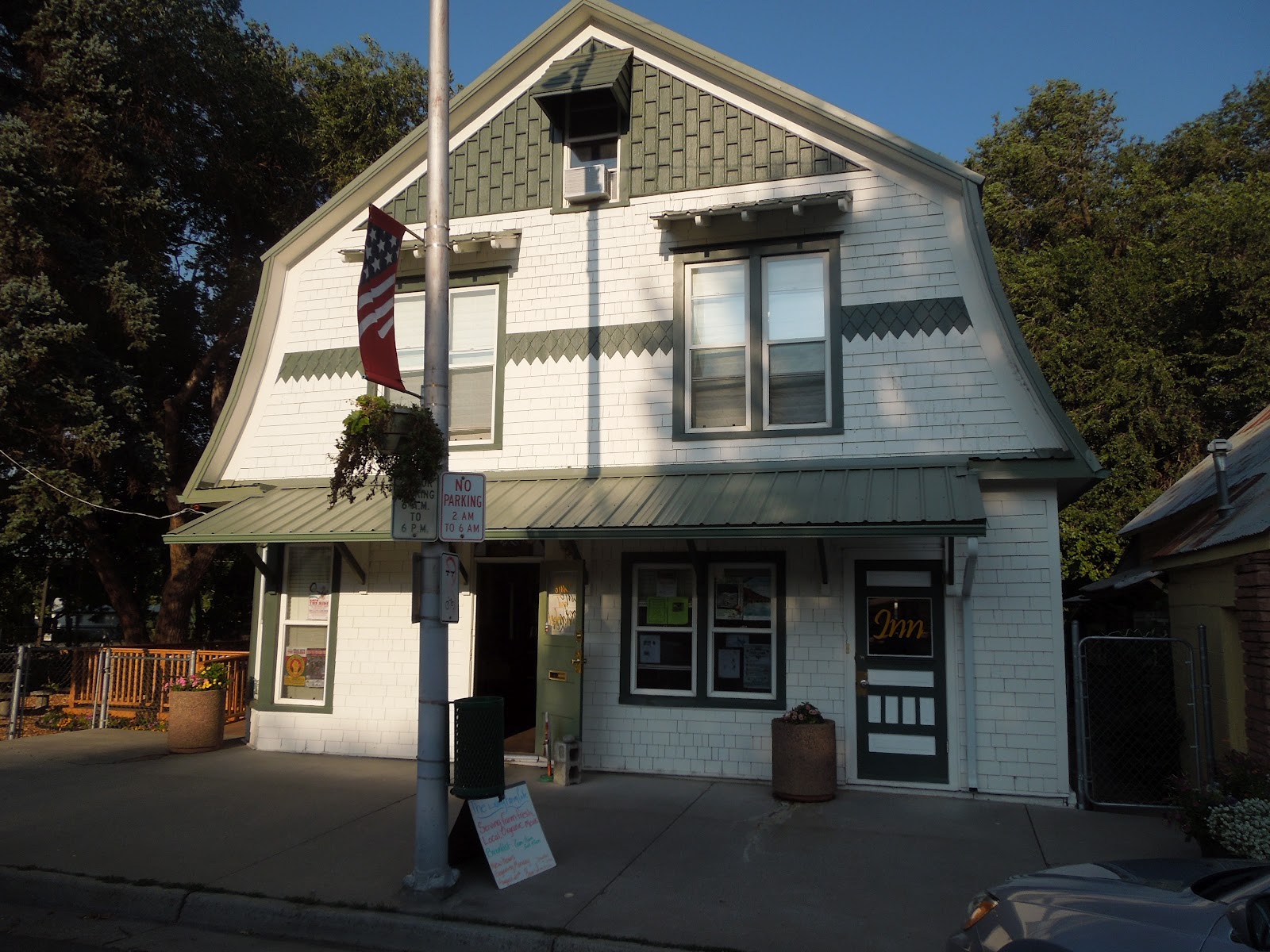
We rested at a B & B called The Living Farm Café (on Grand Avenue in quaint downtown Paonia) owned by the Gillespie family that has farmed in the area since 1938. The café specializes in serving harvest appropriate organic meals that offer gluten free, dairy free, and vegetarian options.  The rooms were homey, spotless and simple with comfortable inviting beds adorned in crisp white sheets and patchwork quilts. The folks were easy going and friendly! To cool down on a hot summer evening we walked down to Ollie’s Ice Cream Parlor and had a few delicious scoops.

On to our final destination—the North Rim of the Black Canyon of the Gunnison.  It is a magnificent and ancient Precambrian carving of the earth by the river and is surrounded by the Pinyon-Juniper woodland community and big sagebrush.  The fragrance of the air is a glorious mixture of pine, juniper, sage and sunshine that I adore.  Hopefully, my photos can say a thousand words of how utterly beautiful this canyon is.  For over two hours, we never saw another human being (except the ranger at the station). We could hear two climbers across the canyon shouting “on belay or off belay;” but without our binoculars we could not see them on the rock face.  When we embarked on the 3 mile loop trail to “Exclamation Point,” a female elk immediately made her presence known (no time to get my camera out), crossing the path only yards away.  This elk crossing was precursor of many marvelous views to come of this awesome canyon.  At Exclamation Point our hearts pounded as we looked over the cliffs to the thin silver sliver of the Gunnison River below. I have not been to the Grand Canyon National Park yet but this view was spectacular! Exclamation Point!

Black Canyon of the Gunnison
Another view of the canyon
The sliver of the Gunnison River far below

On the way back to civilization we soaked in the Glenwood Hot Springs Pool and stayed at the historic Hotel Colorado, the same hotel President Teddy Roosevelt had frequented often. We sat out on the veranda overlooking the region’s red-rocked mountain and sipped a cocktail. It was a view unlike the backyard at home and we felt like we had been somewhere. The trip was like hitting a refresh button and we were enchanted by the experience.


References
http://www.nps.gov/index.htm
http://www.nps.gov/blca/index.htm
http://en.wikipedia.org/wiki/List_of_national_parks_of_the_United_States
http://www.redstonecolorado.com/
http://www.northforkvalley.net/
http://www.stonecottagecellars.com/
http://thelivingfarmcafe.com/
http://csfs.colostate.edu/pages/forest-types-pinon-juniper.html
http://cpluhna.nau.edu/Biota/pinyon-juniper.htm
http://www.hotspringspool.com/
http://hotelcolorado.com/